What are the advantages of replacing sand with Watercel ZN?
3 min read
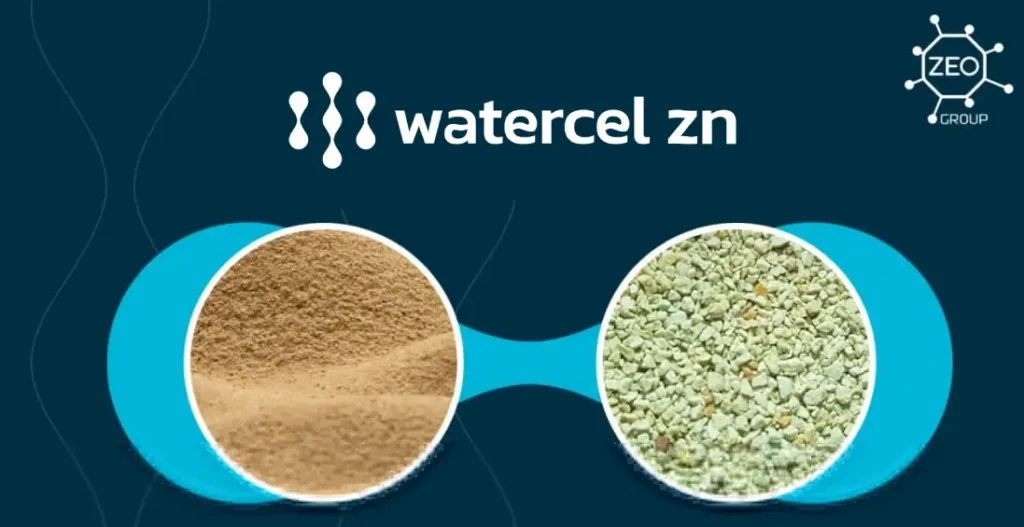
Watercel ZN is a filter medium developed from natural Clinoptilolite zeolite, a material with high porosity capable of removing particles from 5 microns. This characteristic allows the filter to achieve high turbidity reduction capacity, depth filtration action, and, consequently, longer filtration runs. It is estimated that sand has a particulate removal capacity starting from 20 microns and surface filtration action, which restricts filtration runs (lower amount of water produced).
Another difference between sand and zeolite is the bulk density. Zeolite has a density of 0,90 to 0,98 g/cm³, 30% lower than sand (1,3 to 1,5 g/cm³). This characteristic of Watercel ZN reflects in a lower weight quantity (considering identical volumes) of material to be installed in the filters, as well as ease and operational savings in backwash stages.
Comparative Evaluation
Analyzing a case of a real Brazilian WTP in full operation, the objective was to perform a Retrofitting of the entire Sand bed with Watercel ZN. Considering the basic data of the WTP, we have:
Conventional WTP with chemical dosing → coagulation and flocculation → sedimentation → Filtration.
WTP flow rate: 50 L/s (or 180 m³/h).
Filters: 8 chambers operating in parallel with constant rate.
Data for each filter: Application rate: 240 m³/m².day (or 10 m³/m².h); Area: 2,25 m².
Previous filter bed: 1 layer of Sand (0,5 to 0,8 mm); Height: 400 mm. 3 layers of pebbles; Total height: 350 mm.
New filter bed: 1 layer of Watercel ZN (0,4 to 1,0 mm); Height: 400 mm. Identical support layer.
A) Evaluation of Volume and Quantity of Filter Medium
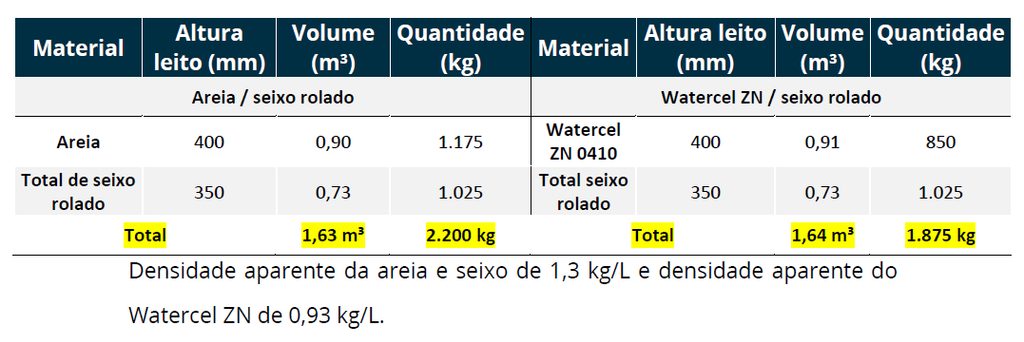
Below we can observe a comparative table between the volumes and quantities of the material previously used (sand and pebbles) and the values applicable for the filter with Watercel ZN.
Considering the values in the table above, 9.400 kg of conventional sand were used to serve the 8 filters; replacing the media with zeolite, 6.800 kg of Watercel ZN were required.
The difference of 2.600 kg represents savings in product transport and bed replacements, which reflects in savings in logistics costs and in the operation of filling the tanks/filters.
B) Evaluation of Savings in the Backwash Operation
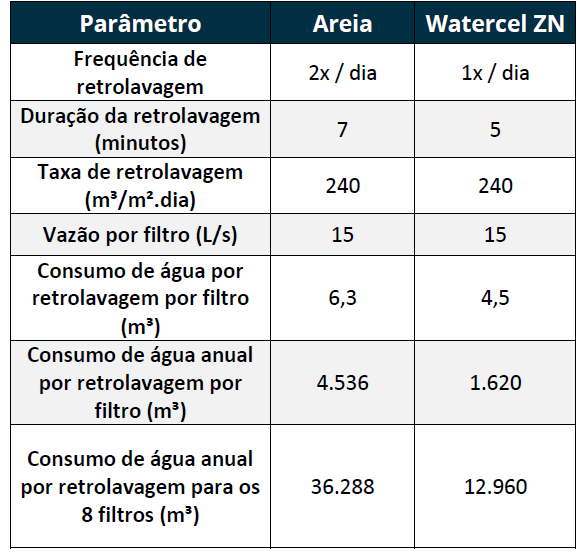
The table below presents comparative values between rates, flow rates, and volume of water spent in a backwash.
It is observed that the annual savings for the backwash process was 64,3%, a volume of 23.328 m³. Considering that the filter backwash is performed with treated water, one can consider significant savings in water and waste of chemical inputs.
Based on the demonstrations presented here, we can summarize the following advantages in applying Watercel ZN compared to the conventional sand bed:
Possibility of higher water production for longer (longer filtration run), meeting the turbidity standard of 0,50 NTU (GM/MS No. 888/2021).
Lower quantity of filter medium, on the order of 27,7%, with savings in logistics costs.
Annual water savings through the backwash process on the order of 64,3% (23.328 m³).
And you, do you already use Watercel ZN instead of Sand? Tell us about the advantages you see in your daily routine with this product!