Watercel ZN: a granular filter media alternative in tertiary filters used for polishing treated effluents
4 min read
The growing scarcity of water resources and frequent droughts demand the implementation of strategies for tertiary treatment and the responsible pursuit of treated effluent reuse. Tertiary filtration presents itself as an efficient and economical solution, especially when associated with disinfection technologies. This article aims to clarify some recurring questions for our audience, such as:
Is Watercel ZN capable of reducing BOD5,20°C and COD of wastewater?
Wastewater organic matter is quantified indirectly by the Biochemical Oxygen Demand (BOD5,20°C) or Chemical Oxygen Demand (COD) analysis. In general, BOD5,20°C is a slow analysis expressed as mg of O2/L, which represents the amount of oxygen used by microorganisms to degrade the biodegradable organic matter of a sample incubated under controlled conditions of temperature (20 °C) and time (5 days).
COD refers to the amount of oxygen consumed by all the organic matter in an effluent sample through a chemical agent (oxidant), such as potassium dichromate (K₂Cr₂O₇). It is a chemical analysis that takes between 2 to 3 hours, at a temperature of 150 °C. It is the total oxidation of organic matter (biodegradable + non-biodegradable organic matter), therefore, the COD value will always be higher than the BOD value for the same sample.
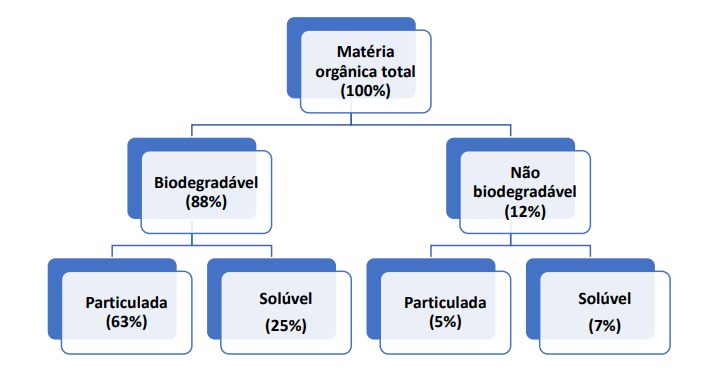
However, not all organic matter present in wastewater will be soluble. The figure below represents a typical distribution of organic matter in raw sanitary sewage:
Depending on the type of effluent, the fractions show variations. For example, an effluent originating from vinasse (residue from the sugarcane process) has a higher amount of soluble biodegradable matter (~80%) than an effluent from the petrochemical industry that contains only 20%.
But what about zeolites? Do they replace biological systems in reducing BOD or COD of effluents? How should we employ them in the process?
Since the natural zeolite Watercel ZN is a filter medium for removing suspended solids, it can only be used as a polishing step for the WWTP, never for raw sewage.
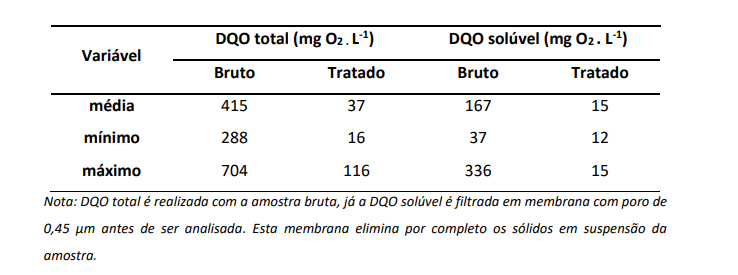
Thus, we need to evaluate the distribution of the effluent COD at the WWTP to design the best application condition for Watercel ZN. The table below represents the typical composition of raw and treated sanitary sewage from an activated sludge WWTP:
The difference between total COD and soluble COD is called particulate COD; in this case, the average was 22 mgO₂/L (60% of total COD). Thus, if we consider a removal efficiency of 100% of suspended solids via filtration, the final effluent COD will be equal to the soluble one (15 mgO₂/L) and there will, therefore, be an average reduction of 60% of the total COD after the filter, but this number is at least double what is found in practice.
This difference is linked to the distribution of the average diameters of the suspended solids; in this case, Watercel ZN will be able to capture solids with a diameter larger than 5,0 μm. Thus, the typical COD reduction value is on the order of 25 to 30% for domestic sewage treated by the activated sludge process.
In general, the zeolite Watercel ZN can assist in the reduction of particulate COD and BOD as a final polishing step for the effluent. However, the filter media should not be applied for the treatment of raw effluent.
Conclusion
Considering the simplicity of operation and the low cost of tertiary filters compared to more complex techniques, this technology can prove to be a feasible route for the production of final effluents with low turbidity and a profile suitable for proceeding to a disinfection stage and becoming a possible source of recycled water.
In this way, the Watercel ZN line will be able to assist you in treating your effluent in a practical and effective manner.
However, we always like to emphasize that the use of a pilot unit, as a preliminary study, can be a powerful tool for obtaining results in the search for optimized solutions.