Understanding the disinfection process and the formation of chloramines in swimming pools
4 min read
When we talk about the disinfection process in a swimming pool, it is important to mention that the main objective is not the complete elimination of all microorganisms present in the liquid phase, but rather to achieve a reduction to levels considered safe from a microbiological point of view, thus ensuring the health of pool users.
Among the main substances used in swimming pool disinfection processes are non-stabilized chlorinated derivatives, for example, sodium hypochlorite and calcium hypochlorite.
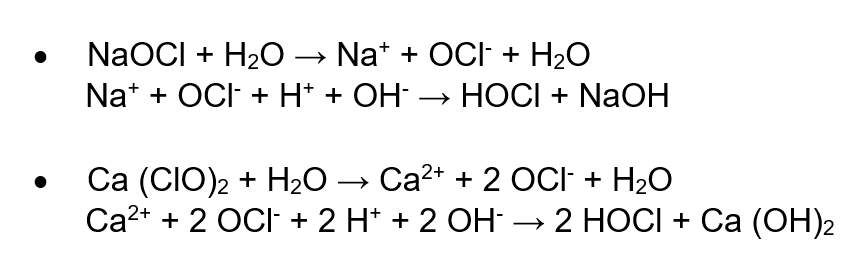
When applied in the liquid phase, their main reactions are as follows:
Thus, we verify that through hydrolysis reactions both produce hypochlorous acid (HOCl). Because it is a weak acid, hypochlorous acid dissociates in the liquid phase, allowing for the formation of the hypochlorite ion (ClO⁻), through the following expression:
The distribution profile of hypochlorous acid and hypochlorite ion in pool water is directly related to the pH value maintained in the water.
For a temperature of 25ºC and a pH of 7,5, we obtain a distribution of 50% hypochlorous acid and 50% hypochlorite ion.
The sum of the molar concentrations of both species is what we call Free Residual Chlorine.
However, it is important to emphasize that chlorinated derivatives, when added to pool water, participate in a set of reactions, causing their concentrations to change over time. Among these reactions, the most representative are:
Reactions with Ultraviolet Light.
Reactions with Inorganic Compounds.
Reactions with Organic Compounds.
Reactions with Ammonia.
Based on the main objective of this article, we will present, in summary, the most relevant points regarding the reaction of chlorine with ammonia and its influence on the environment surrounding the use of swimming pools.
How are Nitrogen-based contaminants primarily introduced into pool water?
Through perspiration (sweat).
Through urine.
Which main Nitrogen-based contaminants are present in pool water?
Ammonia.
Urea.
Creatinine.
What is the behavior of the chlorinated derivative (dosed in pool water) in the presence of ammonium ion (NH₄⁺)?
In the presence of ammonium ion, the formation of compounds called chloramines occurs, that is, resulting from the reaction of the ammonium ion with hypochlorous acid (HOCl), according to the following reactions:
Therefore, we call Combined Residual Chlorine the sum of the concentrations of Monochloramine, Dichloramine, and Trichloramine. The distribution of each species in the liquid phase is a function of the pH of the medium and the ratio between chlorine and ammonia (Cl₂/NH₃).
Consequently, we define Total Residual Chlorine (TRC) as the sum of the concentrations of Free Residual Chlorine (FRC) and Combined Residual Chlorine (CRC).
It is worth emphasizing that the chlorination process applied in swimming pools must always prioritize the maintenance of Free Residual Chlorine, that is, the release of only HOCl and OCl⁻, thus ensuring adequate disinfection and protection for users.
Thus, it becomes fundamental to act preventively in order to minimize the formation of chloramines in swimming pools as much as possible, because in addition to causing discomfort to users, they act severely as consumers of FRC.
What are the negative effects generated by the presence of chloramines in swimming pools?
Severe skin irritation for bathers.
Severe eye irritation for bathers.
Marked reduction in the water disinfection process of the pool.
Corrosion in facilities.
Strong and offensive “chlorine” odor (in reality, it is the absence of FRC and the presence of Chloramines) in the pool area.
Discomfort in the respiratory tract of users, especially in closed environments.
What are the main prevention and control actions to mitigate the formation of chloramines in swimming pools?
Awareness regarding personal hygiene practices (showering before entering the pool, avoiding urinating in the pool, etc.).
Adequate control of the physical-chemical characteristics of the pool water.
Respecting the pool occupancy rate.
Always ensure continuous chlorination to the “break-point”.
Use of filters filled with Zeolite (Celpool).
Alternative processes, such as: Ozone and UV.
How can Celpool be an important ally in the search for health, comfort, and savings for the millions of swimming pool users in Brazil and around the world?
By partially removing the ammonium ion (NH₄⁺) present in the water, through the ion exchange mechanism, thus minimizing the possibility of chloramine formation.
Reducing the demand for the chlorinated derivative consumed during the chloramine formation reaction.
Efficiency in the filtration process due to the product’s characteristics and operational conditions (backwash rate), as well as a reduction in water, energy, and chemical consumption.
BIBLIOGRAPHIC REFERENCES
CELTA BRASIL. CELPOOL technical data sheet, FT0208 – Revision no. 02. Updated version on 03/07/2023.
FERREIRA FILHO, Sidney S. Water treatment: Conception, design, and operation of treatment plants. 1th Edition. Rio de Janeiro: Elsevier, 2017.
MACEDO, J.A.B. Swimming Pool – Water & Treatment & Chemistry (Contemporary Pool Science). 2th Edition. Belo Horizonte: CRQ-MG. 2019.
MAIERÁ, N. Swimming pools liter by liter 2. ed. Revised and expanded. São Paulo: Esedra, 2009.